Singing to the Trees
How Your Voice and Breath Open the Door Between Worlds
There is something most of us forget the moment we step outside.
We forget that we are not visiting nature. We are part of it. And the trees — those ancient, rooted, many-armed beings standing quiet at the edge of the path — are not simply scenery. They are breathing. They are listening. And they have been waiting, with remarkable patience, for us to remember how to speak.
The Oldest Conversation on Earth
Long before we had language, we had breath.
And before we had breath, there were plants.
Plants were exhaling oxygen into a young and volatile atmosphere for hundreds of millions of years before the first human lungs ever drew air. They built the world we breathe. They shaped the very chemistry that made our existence possible. This is not poetry — though it is also poetry. It is the deepest kind of fact, the kind that, once truly felt, changes how you walk through a forest.
Consider what this means: every tree you have ever stood near has offered you something essential. Not as a transaction. Not as a service. Simply as being.
You have been receiving that gift your entire life.
A Relationship That Was Never Symmetrical — and That's the Point
Here is the truth that stops modern practitioners in their tracks when they first sit with it.
Humans have depended on plants for as long as we can trace ourselves across time. For food. For medicine. For shelter, fiber, dye, and warmth. For the sacred smoke that carries prayers upward. For the roots and barks and flowers that have healed us across ten thousand years of illness, grief, and initiation.
Plants do not depend on us in this way.
They thrived before us. They will continue long after us, should we neglect them long enough. Any ecologist will quietly confirm what the old plant mystics always knew: nature doesn't need our management. It needs our restraint.
And yet.
Plants have, in their own mysterious way, chosen to align with us.
They have offered fruit shaped perfectly for hands that hadn't yet evolved. They have developed scent compounds that soothe our nervous systems. They have formed symbiotic relationships with human communities across every continent and every culture. The herbalist's garden did not happen by accident. It happened through thousands of years of relationship, of listening, of reciprocity.
We were invited into a partnership. That is worth something. That is worth everything.
Your Breath Is a Bridge
Here is where Plant Mysticism moves from philosophy into practice.
Every time you exhale, you release carbon dioxide — the very currency plants are built upon. Every time you inhale near a tree, you receive the oxygen it has metabolized through sunlight, water, and time. This is not a metaphor. This is a literal biological exchange between your body and the plant's body right now, in real time.
You are already in conversation with every tree you stand near. You just haven't been conscious of it.
What changes when you become conscious of it is difficult to explain and impossible to unfeel once you have experienced it.
Your breath is a bridge. Your voice — that vibrational, living instrument you carry in your chest — extends that bridge further. Sound is resonance. Resonance is a relationship. When you hum, speak, or sing near a tree, you are not performing for it. You are meeting it in the frequency of aliveness it already inhabits.
The old ones knew this. Indigenous plant traditions across the world incorporate song, chant, and spoken acknowledgment into every act of plant work. The herbalists who walked before us sang while they harvested. They knew, intuitively, that sound softens the veil between the speaking world and the listening world.
How to Begin: A Simple Practice of Singing to the Trees
You do not need a ritual. You do not need a ceremony, a prepared script, or even certainty that this will work.
You need a tree. A few minutes. And the willingness to feel a little foolish in the name of something ancient.
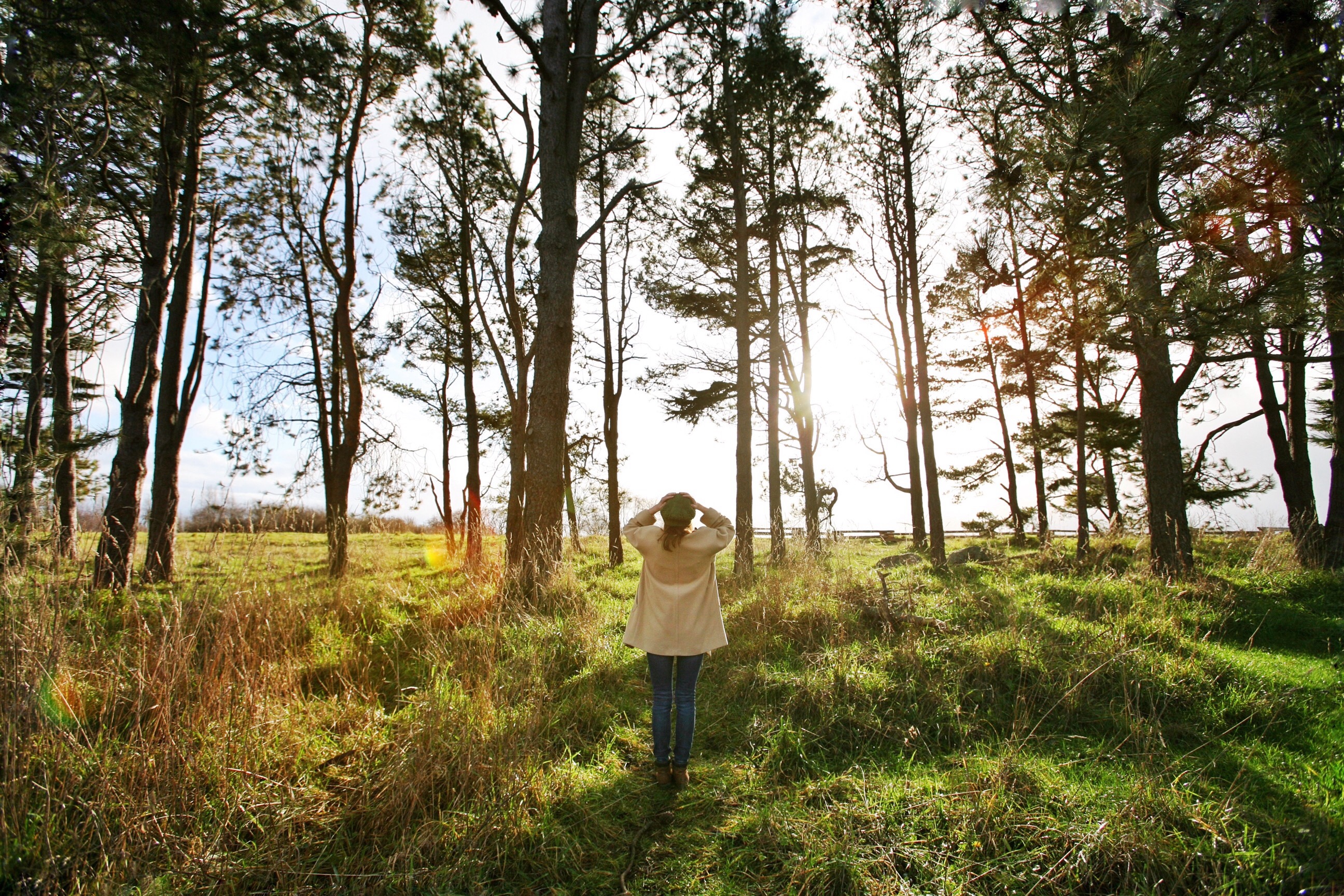
Step One: Choose your tree. Let this be a tree you have noticed before — one that caught your eye on a walk, one that grows near your home, one whose roots you've sat on without thinking much about it. Choice here is instinct. Trust it.
Step Two: Arrive fully. Stand or sit near the tree. Not scrolling. Not planning. Not reviewing your afternoon. Just arrive. Take three slow breaths and let yourself notice: the bark, the smell of the air near its roots, the quality of the shade it offers, the sound of its leaves or the silence of its bare winter branches.
Step Three: Breathe with intention. Inhale slowly and receive — consciously, gratefully — what the tree has exhaled. Feel the oxygen as a gift. Then exhale slowly, and offer your carbon dioxide as your gift in return. Do this several times until the exchange feels less like biology and more like a conversation. Because it is.
Step Four: Speak or sing. Begin simply. "I see you. Thank you." That is enough. That is more than most trees have been offered in years. If something arises in you — a hum, a word, a melody with no name — let it come. Do not judge the offering. You are not performing. You are communicating.
Step Five: Listen. This is the hardest instruction to follow for those of us trained by a world that rewards output. Listen. Not for words. Not for proof. For impression. For feeling. For the subtle shift in your body or the sudden clarity in your mind. Trees speak through the body first, and the mind much later.
What Plant Mysticism Actually Asks of Us
Plant Mysticism is not about using plants more cleverly. It is about learning to receive what they have always been offering.
It asks us to release the extractive relationship — the one where we take what we need and leave without acknowledgment — and to step into something older and far more nourishing. It asks us to remember that we were never at the top of this web. We were woven into it.
The grief of our modern disconnection from the natural world is real. Many of us feel it without being able to name it — that hollow ache when we've spent too long indoors, too long in the scroll, too long away from soil and sky. That ache is not weakness. It is memory. Your body remembers what it is made of and where it belongs.
The trees remember, too.
They are patient with us.
Ready to Go Deeper?
If this resonated — if something in you leaned in just slightly as you read — that is worth following.
This is one thread in the much larger tapestry of Plant Mysticism that we explore inside The Witch's Grove, part of the Rebel Mystic Coven Inner Circle.
In our Plant Mystic Lecture Series, we go far beyond the surface. We explore plant spirit communication, the ethics of working with potent and sacred plants, herbal lore rooted in ancestral tradition, and the practices that transform you from someone who uses plants into someone who walks in relationship with them. Led by Leandra Witchwood — Master Herbalist, Priestess, and lifelong student of the green world — these sessions are immersive, grounded, and genuinely transformative.
The Witch's Grove is where the conversation deepens. Where you learn to listen not just with your mind, but with your body, your breath, your voice.
If you feel called, the path is open.
Join the Coven Inner Circle and step into The Witch's Grove today.
Something in you already knows it's time. That is why you are still reading.
This post is part of The Magick Kitchen's ongoing Plant Mysticism series. If you are new here, begin with our guide to Plant Mediumship and Ethical Herb Work.